How to Take It
- Click Start the Test to answer all 14 everyday dilemmas one scenario per screen.
- Tap the choice closest to your real habit (or press keys 1–4) to advance automatically, or click Back to revisit a question.
- Read your strongest heavenly virtue illustration, Closest Shadow Sin badge, and all seven colored balance bars on the result screen.
- Download a 1080×1920 Story card, copy your shareable result link (#r=...), or click Retake Test to run again.
Sample Result Profiles
| Sample Answers | Outcome |
|---|---|
| Generous helper (Charity high, Sloth shadow) 1. Your team project wins public praise: Thank everyone and note my part · 2. You receive an unexpected cash bonus: Share part with someone in need · 3. Flirtation appears while committed: Keep conversation polite and brief · 4. A peer gets a promotion you wanted: Wish them well despite feeling sore · +10 more | Strongest Heavenly Virtue: CharityClosest Shadow Sin: Sloth Sharing bonuses and lending gear lifts Charity to 100%, while deferring chores flags Sloth. |
| Measured calm (Patience & Temperance lead) 1. Your team project wins public praise: Thank everyone and note my part · 2. You receive an unexpected cash bonus: Treat close friends and save half · 3. Flirtation appears while committed: Keep conversation polite and brief · 4. A peer gets a promotion you wanted: Wish them well despite feeling sore · +10 more | Strongest Heavenly Virtue: TemperanceClosest Shadow Sin: Envy Tied at 100% between Temperance and Patience, with Envy emerging as the lowest axis. |
| Steady builder (Diligence high, Pride shadow) 1. Your team project wins public praise: Accept full credit without correcting · 2. You receive an unexpected cash bonus: Treat close friends and save half · 3. Flirtation appears while committed: Keep conversation polite and brief · 4. A peer gets a promotion you wanted: Wish them well despite feeling sore · +10 more | Strongest Heavenly Virtue: DiligenceClosest Shadow Sin: Pride Early starts on tasks lift Diligence to 100%, while guarding credit surfaces Pride. |
How Scoring Works
The 14 scenarios cover the seven traditional virtue-sin pairs (two scenarios per pair): Humility vs. Pride, Charity vs. Greed, Chastity vs. Lust, Kindness vs. Envy, Temperance vs. Gluttony, Patience vs. Wrath, and Diligence vs. Sloth.
Each option carries an integer score from 0 (strongest sin pull) to 3 (strongest heavenly virtue pull). Each pair sums to 0–6 and divides by 6 to render a 0%–100% virtue balance meter.
The highest-scoring pair sets Strongest Heavenly Virtue and the lowest-scoring pair identifies Closest Shadow Sin (returning None Dominant at the all-100% or all-0% boundary). Ties follow classical order (Humility through Diligence) and are reported explicitly in Balance Summary.
Historical virtue-versus-sin pairings follow Encyclopaedia Britannica (https://www.britannica.com/topic/seven-deadly-sins and https://www.britannica.com/topic/seven-heavenly-virtues, fetched 2026-11-29) and Wikipedia Seven virtues (https://en.wikipedia.org/wiki/Seven_virtues, fetched 2026-11-29). Britannica lists Gratitude against envy in its seven-deadly-sins entry and lead summary while naming Kindness in its Pope Gregory I historical note; this quiz follows the popular Kindness label.
Privacy and Access
- Price
- Free, with unlimited retakes: $0 and no daily cap.
- Account
- No login and no sign-up required.
- Privacy
- Everything stays on your device and your answers are never uploaded.
- Watermark
- No watermark on your profile or result downloads.
- Export
- Download a vertical Story card or copy a link that opens your exact result.
How Do the 7 Heavenly Virtues Counter the 7 Deadly Sins?
A 7 heavenly virtues test resonates on social media because every virtue stands directly opposite a recognizable human habit. In Roman Catholic theology, Encyclopaedia Britannica’s article on the seven deadly sins notes that the 4th-century ascetic Evagrius Ponticus originally outlined eight harmful dispositions before St. Gregory the Great (who reigned from 590 to 604) refined them into seven capital sins in Moralia in Job. Later medieval works—including St. Thomas Aquinas’s 13th-century Summa theologiae, Dante’s Divine Comedy, and Chaucer’s Canterbury Tales—explored the seven deadly sins widely, while medieval moral writers also developed the corresponding seven contrary virtues to counter them.
Rather than asking whether you think of yourself as “patient” or “humble” in the abstract, this test frames 14 concrete choices where a virtue and its opposing sin pull in opposite directions:
| Virtue vs. Opposing Sin | Tension Tested in Scenarios | High Virtue Signal | Shadow Sin Signal |
|---|---|---|---|
| Humility vs. Pride | Group praise and bug reports | Sharing credit and fixing errors openly | Guarding status or deflecting critique |
| Charity vs. Greed | Unexpected bonus and lending a drill | Sharing surplus without tight strings | Hoarding resources or refusing easy favors |
| Chastity vs. Lust | Flirtation and late-night impulses | Protecting trust and personal boundaries | Chasing novelty past stated commitments |
| Kindness vs. Envy | Peer promotion and travel photos | Rejoicing genuinely in a friend’s win | Comparing scores or muting peers in resentment |
| Temperance vs. Gluttony | Favorite buffet and auto-play shows | Stopping comfortably while still satisfied | Pushing past fullness or planned bedtime |
| Patience vs. Wrath | Traffic cut-offs and rude group chats | Pausing to keep solutions calm | Escalating with honks or sharp replies |
| Diligence vs. Sloth | Monday deadlines and weekend chores | Starting tedious work ahead of crunch time | Putting off routine duties until forced |
Note on terminology: Encyclopaedia Britannica’s seven deadly sins entry and the lead summary of its seven heavenly virtues entry name Gratitude as the counter-virtue to envy, whereas Britannica’s historical paragraph on Pope Gregory I and most modern online quizzes use Kindness. Both point to the same habit of appreciating what you have and wishing others well.
Why Do Scenario Choices Reveal a Shadow Sin?
On TikTok, many users take both a deadly sins quiz and a seven virtues quiz back to back and joke about landing “50/50.” That split makes practical sense: someone can be unfailingly generous with money and time (Charity) while consistently putting off dull weekend errands (Sloth), or stay composed during heated group chats (Patience) while struggling to turn off late-night episodes (Gluttony).
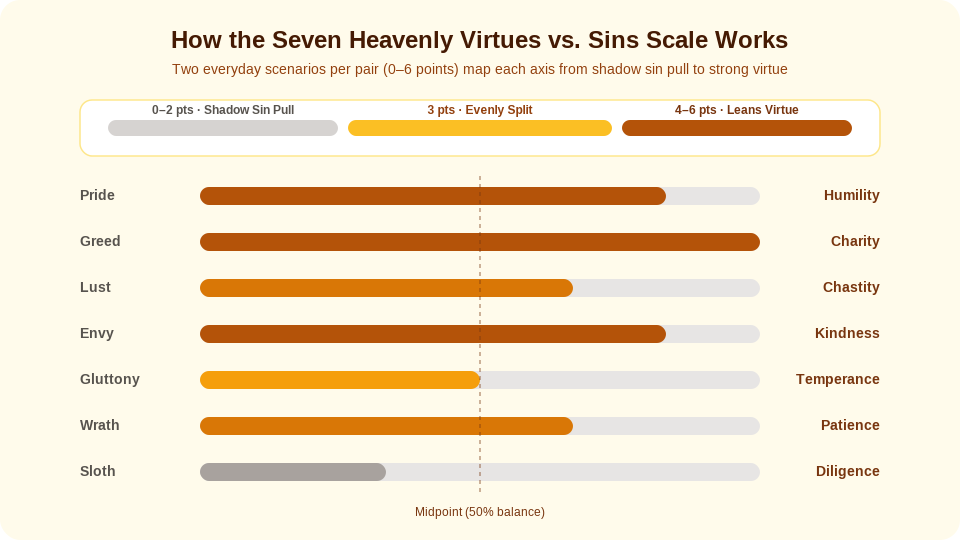
Evaluating all seven axes through realistic dilemmas lets both patterns appear at once. The balance bars show where each pair lands on a 0% to 100% scale:
- Leans Virtue (4 to 6 points, 67% to 100%): Your default reaction aligns closely with the countering heavenly virtue.
- Evenly Split (3 points, 50%): Context decides the outcome—you lean toward the virtue in one situation and feel the shadow pull in another.
- Shadow of Sin (0 to 2 points, 0% to 33%): That particular temptation tends to win in rushed or unguarded moments.
When Should You Use This Test vs. the Quick 7 Virtues Test?
Choose this 7 heavenly virtues test when you want to see how you behave in concrete trade-offs and spot which opposing sin pulls hardest on your habits. If you prefer a faster frequency checklist that rates each virtue on its own 5-point scale without comparing it to a sin, take our homepage 7 Virtues Test. To look up historical origins, Latin names, and how these seven heavenly virtues differ from Plato’s cardinal virtues and St. Paul’s theological virtues, browse our 7 Virtues List and Meanings Explorer.
All scenario scoring steps and historical definitions were verified by the 7 Virtues Test Team on November 29, 2026 against archived references from Encyclopaedia Britannica, Britannica’s seven deadly sins entry, and Wikipedia’s Seven virtues overview. As with every reflection quiz on this site, treat the output as lighthearted insight rather than psychological assessment.
Limits and Caveats
- This 7 heavenly virtues test is designed for entertainment and self-reflection only; it is not a clinical psychological evaluation or moral ranking.
- Real behavior shifts across work, family, and stress levels, so two hypothetical dilemmas per pair cannot capture every nuance of character.
- Scoring a lower balance on one axis highlights a relatable human tension rather than labeling a person as bad or permanently fixed.
Questions People Ask
What makes this 7 heavenly virtues test different from a single-trait quiz?
Instead of rating abstract adjectives, this test places you in 14 everyday dilemmas where each heavenly virtue directly meets its opposing deadly sin, showing both your strongest virtue and your closest shadow sin.
Where do the seven heavenly virtues versus seven deadly sins pairings come from?
Early Christian writer Prudentius staged a battle between seven virtues and seven vices in his 5th-century poem Psychomachia, and Pope Gregory I standardized the seven deadly sins in AD 590, inspiring the seven contrary virtues.
What does Closest Shadow Sin mean in my results?
It simply marks the pair where your scenario choices leaned farthest from the traditional virtue. If all seven pairs score 100%, the quiz reports None Dominant instead of forcing a shadow label.
Can my results show a 50-50 balance between virtues and sins?
Yes. Choosing moderate options produces an Evenly Split band around 50%, mirroring the popular TikTok trend where people discover an almost even mix between classic virtues and everyday temptations.
Do I have to be religious to take the 7 heavenly virtues test?
No. While the seven pairs come from Roman Catholic moral history, every dilemma here focuses on ordinary secular habits such as credit sharing, spending, boundaries, patience in traffic, and finishing weekend chores.
What if two virtues or two shadow sins tie in my score?
The scoring script uses a fixed deterministic tie-breaker following classical order (Humility, Charity, Chastity, Kindness, Temperance, Patience, Diligence) and names every tied virtue or sin inside the Balance Summary.
Updated Written and verified by 7 Virtues Test Team